
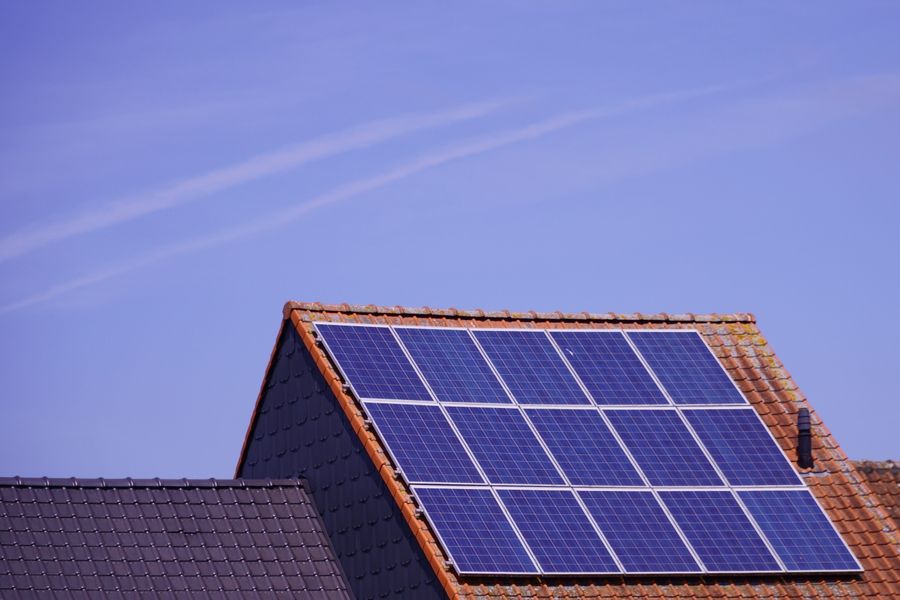
The Sunniest City in America Is Also the Hardest on Solar Panels
Triple digit rooftops cost you real output. The surprise is how little that changes the math.
Read the article
We design and install rooftop solar sized to your real APS or SRP usage, engineered for Sonoran heat, and backed by a local Phoenix team. No pressure, no mystery math, no surprises on install day.
Design, permitting, installation, interconnection and service all run through one point of contact, so you are never left tracking down who owns the problem in year six.
Rooftop systems sized against twelve months of your real usage, engineered for tile, shingle or foam, and built to survive two decades of desert heat cycling.
Warehouses, offices, churches and small business rooftops. We model demand charges first, because that is where commercial bills actually get expensive.
Store the surplus your panels make at noon and spend it at six, when both utilities charge the most. Monsoon season backup power comes along for free.
Inherited a system from a company that vanished? We diagnose underperforming arrays, replace failed inverters and re-flash leaking penetrations.
Production monitoring that tells you when a string drops out, plus rate plan reviews so you are never paying an old plan for a new set of habits.
Sonoran dust and monsoon haboobs quietly shave output every dry month. Scheduled cleaning puts that production back where it belongs.
Most solar proposals are generated from national averages. That works fine in Ohio. Here, a panel bolted flat to a July rooftop runs far above the temperature it was rated at, and a design that ignores that will quietly under deliver for twenty five years.
Standoff height that lets convection pull heat out from under the array instead of trapping it against the roof deck.
Two panels with the same rating can behave very differently at 70 degrees Celsius. We read the temperature coefficient before we quote.
Valley roofs are not shingle roofs. Every penetration gets sealed for monsoon rain and thousands of daily expansion cycles.
A west leaning array gives up a little annual total and gains production at four and five o'clock, which is exactly when your utility charges the most.
Send us twelve months of usage and we will build a real design for your address, model it against your current rate plan, and show you the numbers whether or not they favor going solar.
Arizona moved off full retail net metering years ago. Today the power you use the moment your panels make it is worth full retail, and the surplus you push to the grid is worth a fraction of that. Every design decision we make follows from that one fact.
That is also why a savings estimate built on a national average is close to useless here. Your rate plan, your afternoon habits and your roof orientation move the number more than the brand of panel ever will.
See how savings are calculatedThe 30 percent federal residential credit ended for systems installed after December 31, 2025. Arizona's state credit, the equipment sales tax exemption and the property tax exemption all remain in place, and third party ownership still carries commercial credit value that providers can pass through.
Neither one is universally better, and anybody who tells you otherwise is telling you about their commission. Here is the plain version of each so you can pick on purpose.
You host the system, somebody else owns it. Historically the majority of residential solar in Arizona went in this way, and in 2026 it carries a new advantage: third party owners can still access commercial credit value that homeowners no longer can.
You own the array outright, either with cash or through financing. Ownership gives up the simplicity of a lease and gains the long tail: once the system is paid off, the power it makes costs you nothing at all.
Nothing gets installed until you have seen a real design, a real production estimate and a real cost. If the numbers do not work for your house, we will tell you that instead of selling around it.
Twelve months of APS or SRP history tells us more in five minutes than a walkthrough tells us in an hour.
A layout for your actual roof, production modeled against local heat and shade, and a cost with every line explained.
City plan review, utility interconnection and inspection scheduling all run through us, not through you.
The array goes up, we verify real production at commissioning, and monitoring keeps watching long after we have packed up.
These come up on nearly every call. If yours is not here, ask us directly and you will get the same plain answer.
Read every questionThere is no honest flat answer, because the number follows your usage history, your roof, your electrical panel and your goals. What we can promise is a written proposal built from your address rather than a neighborhood average, at no cost and with no obligation.
Not for purchased residential systems. The federal residential clean energy credit ended for systems installed after December 31, 2025. Arizona's state credit, the equipment sales tax exemption and the property tax exemption all remain in place, and third party owned systems still carry commercial credit value that providers can pass through in the rate.
The agreement transfers to any buyer who qualifies. It is a routine part of closing, and we walk both sides through the paperwork so it does not become a last minute surprise at the title company.
Research consistently finds that solar adds value, though how much varies with system size, ownership structure and local market conditions. Sellers also tend to report that a solar home moves faster than a comparable one without it.
Yes, with a real caveat. Heat reduces a panel's output at the moment it is hottest, sometimes noticeably. Phoenix simply delivers so much sun across the year that a well designed array still comes out far ahead, and airflow, module selection and orientation give back a good share of what temperature takes.
Not on its own. A standard grid tied system shuts down during an outage for the safety of line crews. Adding battery storage is what keeps selected circuits alive when the neighborhood goes dark, which is a large part of why storage has become so popular here.
Every summer you wait is another summer of full price afternoons. One conversation tells you whether solar makes sense for your house, and it costs you nothing but the phone call.
We get asked who else to call almost every week, usually by someone holding three quotes that all look the same. These roundups are our honest answer, built the way we size a system, by looking at the work instead of the ad spend.
We install across metro Phoenix and the surrounding Valley communities. That radius is deliberate. It keeps us close enough that a service call in year eight is a short drive rather than a scheduling problem.
Fill this out and we will pull your usage, model a design for your address, and come back with a number and the reasoning behind it. If solar is a bad fit for your house, we would rather say so now than sell you something you regret in July.
Locally owned solar design, installation and service for metro Phoenix. We size systems to real usage, build them for desert heat, and stay around to service what we install.
One conversation tells you whether your roof is worth covering. It costs nothing to find out.
Get My Free Quote

